Institut Charles Sadron News
Publié le 19/11/2025 par Fall William
Plastic Under Pressure: How Tie-Chains Build Stronger Materials
Researchers, in the Theory and Simulation of Polymers team (TSP) at ICS, have taken a detailed look into what makes bimodal branched polyethylene so reliable in high-pressure pipelines.
Using molecular dynamics simulations, they studied how the internal structure of bimodal semi-crystalline polyethylene, with differing short chain branch content, changes when stretched. They monitored two key topological features in these systems: “tie-chains” (polymer chains that link different crystalline regions) and “entanglements” (where chains get physically interwoven).
They found that for small stretches crystal orientation matters and that if pulled perpendicular to the chain direction the material is stiffer. At large stretches however this initial orientation degrades as crystalline domains are destroyed and rearranged such that the material ‘forgets’ its initial structure. Surprisingly, in branched compounds, the peak-stress (strength) of these materials correlated strongly with the number of tie-chains that survive the deformation. This means tie-chains are the primary stress transmitters in the materials and that entanglements, by contrast, play a secondary role in the mechanical response. In branched compounds, chain sliding is suppressed which helps tie-chains persist at large stretch ratios which appears to be key for this plastic's suitability to extreme conditions.
Understanding the molecular level origins of plastics and the importance of tie-chains in mechanical strength can facilitate engineering of polymer architectures ensuring longer lasting, crack resistant and more reliable materials.
Their findings are published in Nature Portfolio Journal : npj Soft Matter.
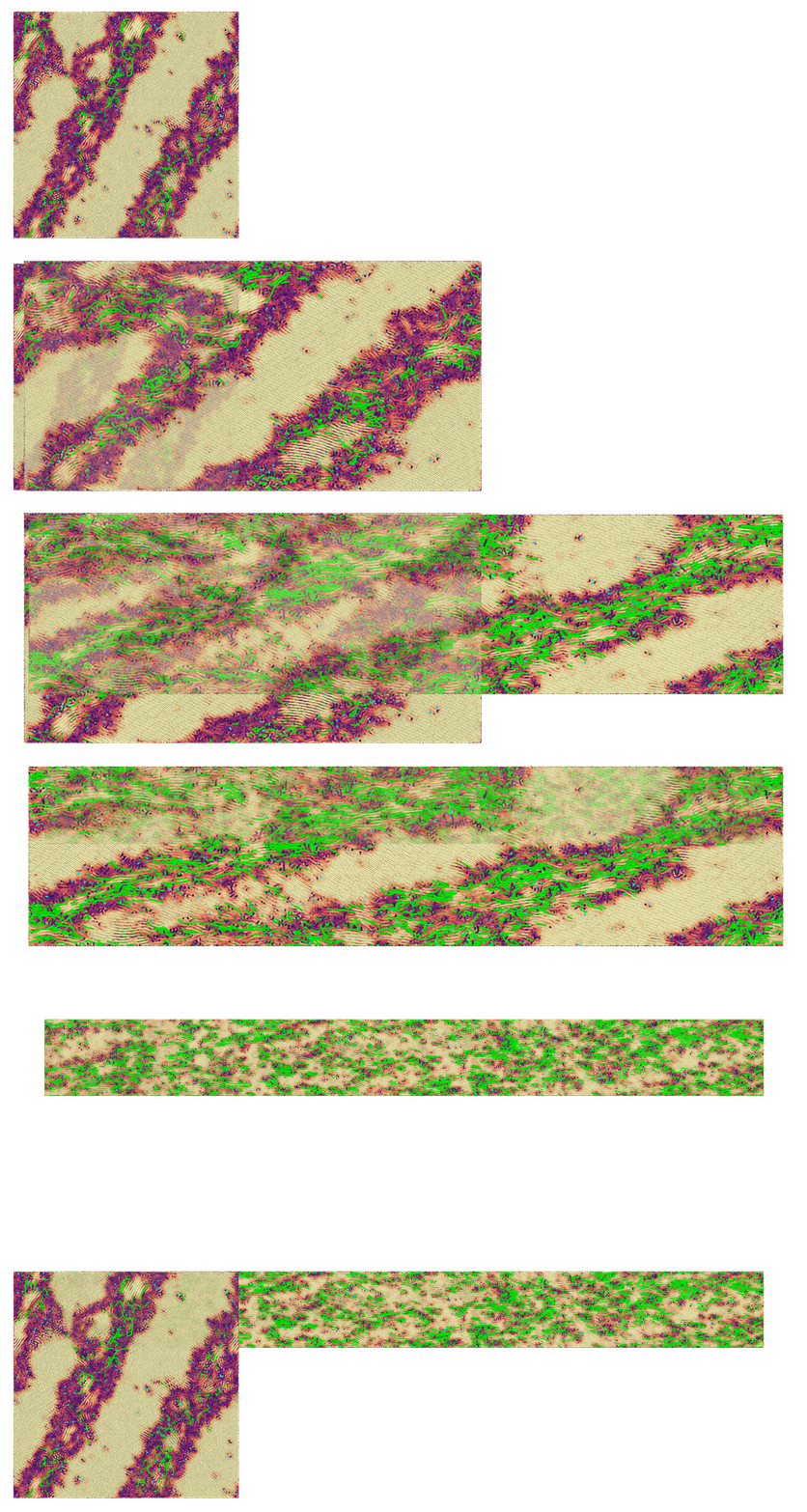
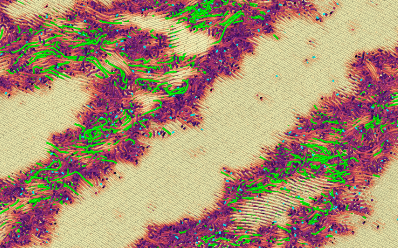
A large-scale semi-crystalline single Polyethylene crystal under deformation in molecular dynamics simulations. Crystalline and amorphous regions are shown in beige or purple respectively. The highlighted green chains are the tie-chains spanning the crystalline domains.